



By Marc C. Shaffer
I recently spent two consecutive Mondays doing something I never imagined would feel intimidating. I blocked four and a half hours each day to sit in a studio and read my own book out loud for the audiobook version.
Even though I spent the last year writing One For All: How to Systemize Kindness, Grow Your Network, and Support Others Like It’s Your Job, I had never actually read it straight through, and certainly not out loud. Truthfully, I rarely ever read out loud. So, walking into Evolution Audio near downtown Kansas City felt like stepping into a whole new world. Thank you to my publisher and team at Streamline Books for the introduction to Evolution Audio!
It is a part of town I do not get to as often anymore, but the moment I stepped inside, the space felt professional, warm, and completely outside my comfort zone. Thankfully, Bryan Nelson, the engineer who guided the entire process, made me feel at ease right away. I had been given a prep guide before recording which included a very logical piece of advice.
Practice reading your book.
Out loud.
I wish I could tell you I made time to do that.
I did not…
It also suggested eating a light breakfast. I did not do that either. I typically have a stomach of steel that never makes a noise, but put me in front of high-end microphones in a soundproof room and suddenly it was like listening to a wild animal looking for lunch. My stomach growled nonstop, and every single rumble echoed with crystal clarity.
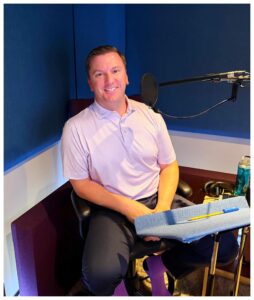 Despite the rocky start, the experience became one of the most meaningful parts of this entire book journey.
Reading every chapter out loud forced me to slow down and absorb the lessons I wrote for others, but also for myself. It reminded me why I started writing this book in the first place. If no one else ever reads it, but my kids someday hear it and understand how much I believe in helping others, investing in relationships, and systemizing kindness, then it was all worth it.
I hope one day Grant and Emily will listen to this audiobook and feel proud. Proud that their dad lived what he wrote. Proud that they grew up watching kindness in action. Proud that the values in the book were demonstrated in our home long before they were ever printed on a page. If that is the legacy I leave, then I feel like this project has been a complete success.
Of course, the actual reading was not as smooth as I imagined!
I quickly learned that when I read silently, I skip over a surprising number of words. Apparently, I am great at “filling in the gaps” mentally, but an audiobook requires every single word to be spoken exactly as written. That meant lots of pausing, redoing lines, and occasionally spending a solid five minutes trying to accurately pronounce a word I wrote myself.
If you’re ever in this position, here are a few tips:
Prep the Script Thoroughly
- Read the entire book aloud at least once beforehand. You’ll catch difficult passages, unfamiliar names, and tonal shifts.
- Mark up your script with notes for emotion, pacing, character voices, and pauses.
- Look up proper pronunciation of names, locations, or technical words.
Pace Yourself
Recording an audiobook is physically demanding.
- Expect roughly 6:1 ratio of time spent recording/editing per finished hour.
- Take breaks every 20–30 minutes.
- Keep your energy even because listeners can hear fatigue.
Manage Mouth Noise & Breath Control
- Drink room-temperature water frequently.
- Use apple slices or green apple juice to reduce clicks.
- Practice breathing so inhalations don’t become distracting.
Practice Reading Like a Narrator, Not a Writer
- Focus on clarity, warmth, and intention.
- Maintain a natural, slightly slower-than-conversation pace.
- Imagine speaking to one listener to make the performance intimate.
Bryan deserves all the credit in the world for his patience and his eagle ear. He caught every missed word, every stumble, and every mispronunciation. If it made the final cut, it is because he would not let anything slide. I was genuinely touched when he showed up at my book launch party a few weeks later. It reminded me how quickly relationships can form and deepen. Even if you only spend a few hours together in a studio, there is still an opportunity for connection.
After two long sessions, I thought we were done. But I had to come back a third time to fix fewer than ten sentences. When we wrapped that final session, we laughed and joked about how I hoped I would never have to see him again. Then we laughed a little more and agreed that I actually do hope we see each other again, maybe when I am recording my next book.
Stay tuned for updates on that project in 2026.
Recording this audiobook taught me a lot about vulnerability and growth and the importance of saying yes to experiences that stretch you. It was harder than I expected. It was more meaningful than I anticipated. And I will always be grateful that I showed up, read the words I wrote, and captured a piece of my legacy in a format my kids can hold onto forever.