



By Marc C. Shaffer
Marc C. Shaffer is a financial advisor in Overland Park, Kansas, working with clients in the Kansas City area, Phoenix, and Utah Valley.
For many families, financial planning eventually becomes about more than investments, retirement accounts, or tax strategies. Questions begin to emerge around family communication, legacy, charitable giving, business succession, and preparing future generations to manage wealth responsibly. In some cases, parents and grandparents want to pass down not only financial assets, but also the values, opportunities, and relationships that matter most to them. Yet those conversations are not always easy to navigate.
As families grow and multiple generations become involved in financial decision-making, the emotional and relational side of planning often becomes just as important as the technical side. At Searcy Financial® Services and Allos Investment Advisors, we enjoy working with families where two or even three generations of the same family have engaged us. That growing need for thoughtful multigenerational planning conversations is what led me to Pittsburgh this summer to complete the 21/64 Certified Advisor training.
Over time, though, we’ve found ourselves facilitating more conversations around:
- family wealth transitions,
- estate planning coordination,
- charitable giving,
- business succession,
- and family legacy discussions.
It has honestly become one of the most rewarding parts of our work. It is fascinating to learn more about our clients when the full family is together sharing stories, discussing childhood memories, talking through priorities, and revealing the personalities that shape how each generation views money and decision-making.

View from the Pittsburgh Community Foundation during the 21/64 Certified Advisor training in downtown Pittsburgh.
Why This Matters for Families
Many families spend years preparing financial assets for transfer. In some cases, less time is spent preparing heirs for the responsibilities and emotions that may come with those transitions.
That is one reason multigenerational planning conversations can become so valuable. When families communicate intentionally, they may be better positioned to:
- clarify goals and expectations,
- reduce misunderstandings,
- discuss charitable priorities,
- prepare younger generations gradually,
- and create more continuity around family values.
Every family is different, of course. Some families are very open about finances, while others prefer more privacy. Some conversations happen naturally. Others may require more structure and facilitation. As a fiduciary financial advisor, I believe there is value in helping families create space for those conversations when appropriate.
Why This Training Resonated With Me
One reason this training felt so natural for me is because it connected closely with my educational background at Kansas State University, where I studied Family Studies and Human Services. The College of Human Ecology at K-State had a motto that has stayed with me for years:
“In a world focused on things, we first focus on people.”
That philosophy aligns incredibly well with the 21/64 approach. In financial planning, it can be easy for conversations to become centered entirely around accounts, legal documents, tax strategies, or investment performance. Those topics matter, but families themselves are often trying to navigate much bigger questions:
- What values do we want to pass down?
- How do we prepare future generations responsibly?
- What does legacy actually mean to us?
- How do we talk openly about money without creating tension?
- How can giving become more intentional?
Those are not purely technical conversations. They are human conversations.
The Most Interesting Part of the Training
One of the things I appreciated most about the 21/64 program was how interactive and experiential it was. This was not a classroom filled with charts, formulas, or technical lectures. In fact, I was the only guy in the training group. Honestly, that did not surprise me much. The program leans heavily into communication, reflection, emotional intelligence, and relationship-building. Those topics have not always received as much attention within traditional financial advisor training programs, even though they can play a major role in family decision-making. The training included several exercises designed to help participants better understand how life experiences shape financial attitudes and behaviors.
Generational Profiles
One exercise focused on generational experiences and upbringing. Participants explored how different generations were shaped by:
- economic events,
- family experiences,
- cultural expectations,
- technology,
- and major historical moments.
It created thoughtful discussions around why people within the same family may approach money very differently. Someone raised during economic uncertainty may prioritize security and savings. Another family member who grew up during a strong economic expansion may feel more comfortable taking risks or spending more freely. Neither perspective is necessarily wrong. They are often reflections of lived experience. That understanding can become incredibly valuable during estate planning conversations, business transitions, or family decision-making meetings.
The “Picture Your Legacy” Exercise
One of the most memorable exercises was called Picture Your Legacy. Participants used visual image cards and value cards to identify themes that represented their own ideas of legacy and impact. The exercise intentionally moves beyond purely logical discussions and encourages more personal reflection. The three cards I selected were:
- Relationships
- Leadership
- Personal Growth
That combination probably says a lot about how I view both life and financial planning. To me, legacy is not simply about passing down assets. It can also involve:
- relationships within a family,
- opportunities created for future generations,
- leadership within a business or community,
- charitable impact,
- and personal growth over time.
Those conversations often reveal far more about a family than a balance sheet ever could.
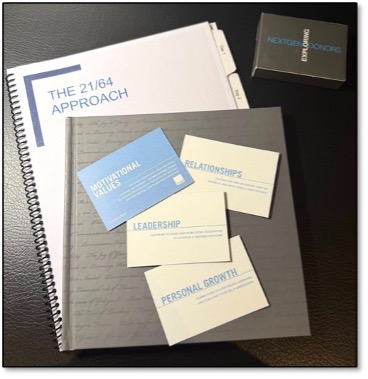
The “Picture Your Legacy” exercise encouraged participants to reflect on the values and themes that shape their idea of legacy and impact.
Pittsburgh Was a Great Host City
The training itself was hosted at the Pittsburgh Community Foundation on the 10th floor of a downtown building overlooking the city skyline. Pittsburgh ended up being one of the most enjoyable surprise cities I’ve visited in a long time. The downtown energy, bridges, architecture, and riverfront atmosphere reminded me why cities built around strong community identities tend to feel unique. I was also able to catch a Pirates game at PNC Park, which absolutely lived up to its reputation as one of the best downtown baseball stadiums in the country. As a Royals fan, it definitely made me excited for the future downtown stadium project in Kansas City.

An evening at PNC Park during the Pittsburgh trip reminded me how exciting downtown baseball environments can be.
And yes, I also made the required stop at Primanti Bros to try the famous pastrami sandwich with fries piled directly onto the sandwich. It was very good. That said, I’m still taking the Z-Man from Joe’s KC in a head-to-head matchup.

I also made the required stop at Primanti Bros while in Pittsburgh. Very good sandwich, although I’m still loyal to the Z-Man at Joe’s KC.
Final Thoughts
Completing the 21/64 Certified Advisor training reinforced something I’ve believed for a long time: financial planning is ultimately about people. Investment management, retirement planning, tax strategies, and estate planning are all important tools. At the same time, many of the most meaningful outcomes for families come from communication, trust, shared values, and intentional decision-making across generations. As our firm continues working with more multigenerational families, I expect these conversations around legacy, transitions, philanthropy, and family relationships will continue becoming an even more important part of comprehensive financial planning services. In many cases, this is where families choose to work closely with an advisor who can help guide both the technical and human sides of planning.