




By Marc C. Shaffer
Think of a Grey Gap Year as the retirement version of a college gap year, but with higher stakes and very different questions.
A college gap year usually happens before adulthood fully begins. It’s a pause between structure (high school) and the next phase (college or career). Students use it to travel, work, volunteer, or simply figure out who they are and what they want. There’s uncertainty, yes, but also a built-in safety net. Society expects exploration at that age, and the long-term path is still wide open.
A Grey Gap Year, by contrast, comes after decades of structure. Work has dictated schedules, identity, social circles, and a sense of purpose for most of adult life. When that suddenly stops, retirees can find themselves asking questions they didn’t anticipate:
- How do I spend my time now?
- Who am I without my job?
- What gives my days meaning?
Like a college gap year, this phase can involve travel, experimentation, and reflection. But unlike a student gap year, the Grey Gap Year isn’t culturally normalized or openly discussed. Many retirees assume they should feel relaxed and fulfilled right away and are caught off guard when they don’t.
The other key difference is risk. A college student may feel they can afford to “waste” a year while a retiree worries about spending too much, making the wrong lifestyle choices, or committing to a vision of retirement that doesn’t actually fit. Decisions made during the Grey Gap Year, about housing, spending, routines, and relationships, can shape the rest of retirement.
In both cases, the gap year is a transition period, a bridge. The Grey Gap Year exists and needs talked about more so it doesn’t leave people entering it unprepared, without realizing it’s a normal and temporary phase.
Handled thoughtfully, a Grey Gap Year can be a valuable part of retirement: a time to test assumptions, recalibrate expectations, and intentionally design what comes next rather than drifting into it.
I’ve had this discussion with clients over the years, some who had heard about it and some who described it without knowing it had a name. Now that we can name it, we realize it’s something we’ve been planning for years, and can take even more control about the outcome. Let’s learn more…
More About the Grey Gap Year
The Grey Gap Year often occurs in someone’s 60s or early 70s, as it lines up with retirement. It is a time when work obligations have ended, health is still relatively strong, and there is finally the freedom to focus on experiences that were postponed during working years.
An article from Active Traveller highlights this growing trend among people over 50 who want to travel more, explore new places, and fully experience life while they are physically able and mentally engaged. For some, that means extended travel. For others, it might be more frequent trips, more comfortable accommodations, or checking off long-held bucket list goals.
From a lifestyle perspective, the idea makes complete sense. From a financial planning perspective, it is something that needs to be addressed intentionally.
Why Early Retirement Spending Is Often Higher
An easily perceived misconception about retirement is that spending automatically decreases once someone stops working.
In reality, the opposite is often true, at least in the early years.
When people first retire, they typically have more free time, fewer scheduling constraints, and better health than they will later in life. That combination naturally leads to more activity and, often, higher spending. Travel is the clearest example. Many clients tell us they want to travel “while they can,” and that instinct is well founded. The way most people travel at 65 looks very different from how they travel at 85. Planning for higher travel expenses early in retirement, followed by a gradual reduction over time, results in a more realistic and sustainable retirement plan.
Illustrating the Grey Gap Year in Financial Planning
This is where comprehensive financial planning can add value. Instead of assuming that spending remains constant throughout retirement, we use financial planning software to model how expenses are likely to change over time.
Travel is often the first temporary expense we address. We may assume higher travel spending in the early years of retirement, followed by a gradual decline as clients age, and eventually little to no travel spending later on.
When these shifts are clearly reflected in a plan, it helps avoid two common problems.
The first is underestimating early retirement costs and feeling stressed when spending naturally rises. The second is overestimating lifetime spending and unnecessarily limiting enjoyment during the years when people are most able to enjoy it.
Seeing these changes illustrated visually often provides meaningful peace of mind. Clients can see that enjoying retirement early does not require sacrificing long-term financial security.
The Retirement Spending Smile
We often describe retirement spending as following a smile-shaped pattern, and the Grey Gap Year fits squarely within it.
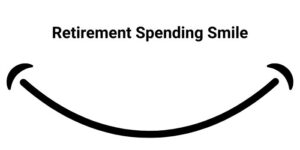
Spending is typically higher at the beginning of retirement, particularly during the Grey Gap Year or years, as people travel more and pursue long-delayed interests. It then levels off and often declines during the middle years of retirement. Later in life, spending may rise again, most commonly due to healthcare and support-related costs.
This pattern reflects how people actually live, not how retirement is sometimes modeled on paper. Acknowledging the retirement spending smile can lead to more honest planning and better decisions. It also can help clients feel more comfortable spending on what matters most, without the constant worry that they are doing something wrong.
One-Time Splurges When the Plan Supports It
Another important aspect of the Grey Gap Year is the role of one-time splurges. These are not ongoing expenses, but intentional choices people feel comfortable making once they see that their retirement plan has a high probability of success.
We have seen clients use this confidence in meaningful ways:
- buying the sports car they have talked about for decades
- choosing first-class flights instead of economy, especially for longer or international trips
- increasing charitable giving as they become more involved with causes they care about
- helping children or grandchildren, knowing that everything else is on track
These decisions are rarely impulsive. They usually come after clients understand that their plan is solid and sustainable. When the foundation is strong, these choices become expressions of values rather than sources of anxiety.
Planning for Real Life, Not Just Numbers
At its core, the Grey Gap Year reflects how many people experience a unique phase of retirement, when health, freedom, and curiosity often overlap.
Thoughtful planning can account for higher spending early in retirement, gradual changes over time, and the commonly observed retirement spending smile. This perspective may help clients approach retirement spending with greater clarity and confidence. It can support more intentional decisions around travel and experiences, encourage thoughtful consideration of meaningful opportunities, and promote realistic expectations as retirement evolves.
In many ways, the Grey Gap Year gives a name to a pattern that is frequently observed.
Retirement is not a single, static stage of life, and financial plans often benefit from being revisited and adjusted as circumstances change.